|

|
|
|
Your comprehensive source for interactive gaming news articles and information
|
|
 |
|
 |
|
|
|
In the game of Blackjack, numbered cards are all valued at their face value and picture cards are all valued at 10. Jacks, Queens, and Kings are considered picture cards and the rest of the cards are all considered numbered cards, except for the Ace. An Ace is always valued at 11 except if the value of the hand exceeds 21. In such a case, the Ace is valued at 1.
For example,
A game of Blackjack begins with every player placing an initial bet before any cards are dealt. Starting with the player to left, the dealer will give each player one card. The first card is always dealt face down. The dealer?s first card is commonly referred to as the dealer?s ?down card?. The player?s second card is also dealt face down. However, the dealer?s second card is dealt face up and is known as the dealer?s ?up card?. At this point, each player can determine the value of their two cards before making one of the following six decisions: hit, stand, double, split, surrender, or purchase insurance.
|
|
|
|
 |
|
Hit If a player is not satisfied with the total of their two initial cards, he or she can ask the dealer to ?hit? which simply means an additional card will be dealt. A player can continue to hit until satisfied with the value of their hand or until their hand exceeds 21.
Stand A player ?stands? when satisfied with the value of the two initial cards. Double If a player is confident that the value of his or her two initial cards is greater than the value of the dealer?s cards, he or she may choose to ?double?. In such a case, the player is required to double their wager and is only permitted to receive one additional card.
Split By receiving two initial cards of the same type (for example, two 5s) a player can choose to ?split? the hand. In such a case, the player is required to double the wager before receiving two additional cards that form two separate hands.
Surrender If a player is unsatisfied with the value of the two initial cards and does not want additional cards, he or she can elect to ?surrender?. By surrendering, a player loses half of their initial bet. A player may not surrender if the dealer has Blackjack (a hand totaling 21).
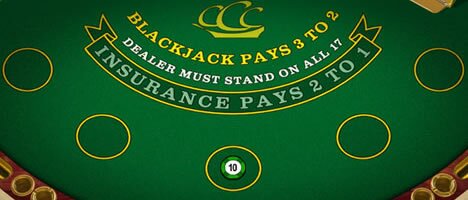
Insurance If the dealer?s up card is an Ace, a player may elect to purchase ?insurance? against a possible Blackjack. In such a case, the player is required to pay half of their original wager but will receive 2 to 1 odds if the dealer has a Blackjack.
|
|
 |
|
|
After all of the players have made their decisions, the dealer will then play his hand. In most cases, the dealer is required to hit if his total is less than 17. The dealer?s strategy is usually written on the Blackjack table.
A player wins if the value of his hand is greater than the value of dealer?s hand or if the dealer busts. If the dealer and player have an equally valued hand then player?s wager is returned
|
|
|
|

|
|